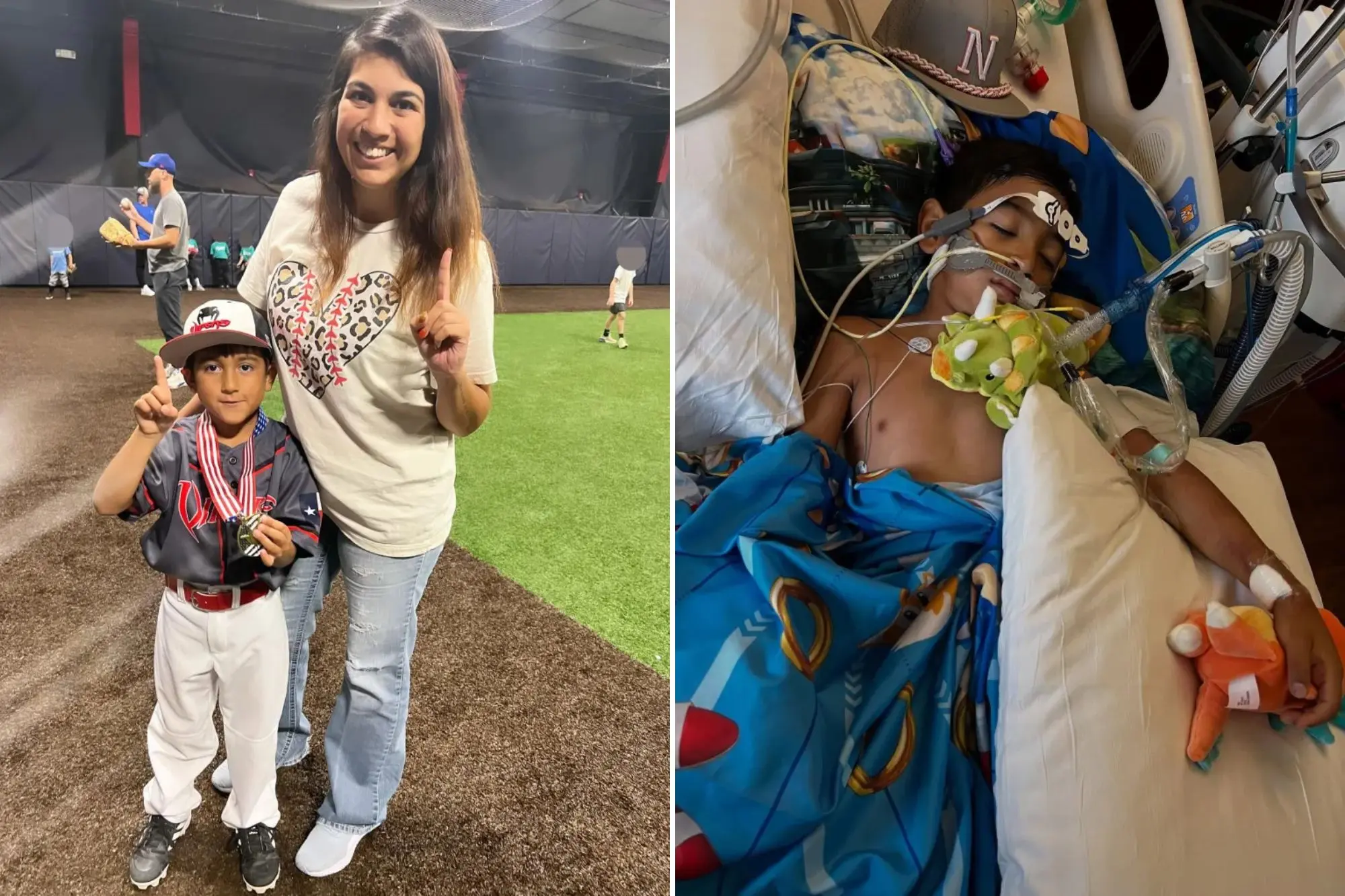

What began as a routine illness quickly turned into a nightmare for a Texas family when their 6-year-old son became paralyzed just hours after being misdiagnosed with the flu.
With nowhere else to turn, his frantic mother turned to Google in the middle of the night — and the information she discovered ultimately saved his life.
“I truly thought I was going to lose him that day,” said Casey Daniel, speaking about her son, Witten Daniel, in an interview with KCBD.

Witten Daniel Gets a Second Chance at Childhood After a Life-Threatening Misdiagnosis
The terrifying ordeal began in April, when 6-year-old Witten Daniel was admitted to the hospital with dizziness and a headache.
Doctors initially diagnosed the flu. But within 24 hours, Witten couldn’t walk, talk, or even breathe on his own — and he soon lost consciousness.
“There are no words to describe how horrifying it is to see your child in that kind of condition,” said his mother, Casey Daniel.
Medical staff rushed to intubate Witten to keep him alive while frantically running tests to uncover the cause of his sudden, severe symptoms.
It wasn’t the flu. Doctors discovered a rare and potentially deadly cluster of blood vessels leaking in his brainstem.
Witten’s condition rapidly deteriorated. Seizures and strokes ravaged his small body, and doctors warned that even if he survived, he might never walk again and could require a ventilator and feeding tube for life.
Casey was in shock. Just two weeks earlier, Witten had been named MVP of his Little League team.

Daniel spent weeks in the hospital as his condition continued to worsen.
Now it was Casey Daniel’s turn to take action — and she didn’t hesitate.
Desperately searching for answers online, Casey came across an article by Dr. Jacques Morcos, a neurosurgeon at UTHealth Houston who specialized in her son’s condition. She sent him a heartfelt email begging for help. Soon, he responded, insisting that Witten be rushed to his facility. There, doctors confirmed he had a life-threatening cavernous malformation.
Cavernous malformations — dangerous clusters of blood vessels — are thought to affect roughly 1 in 500 people, according to the Alliance to Cure Cavernous Malformation.
Symptoms, when they appear, usually show up between ages 20 and 40, with seizures being the most common sign, followed by bleeding and neurological issues such as blurred vision, headaches, weakness, and speech problems.
While most cases have no known cause, about 20% are genetic, and those patients often develop multiple malformations over their lifetime.


Six weeks after surgery, Witten Daniel returned home just in time to celebrate his 7th birthday — a milestone made even more remarkable after everything he had been through.
Shortly after arriving at the new hospital, Witten had been rushed into emergency surgery. For four tense hours, Dr. Jacques Morcos and pediatric neurosurgeon Dr. Manish Shah performed the delicate, high-risk procedure.
Fortunately, it was a success. Within hours, Witten was awake, breathing on his own, and speaking again.
Back home in Lubbock, he celebrated his birthday with family — and more than just another year to mark.
“I want to say thank you to Dr. Morcos and Dr. Shah for letting me see my friends again,” Witten told KCBD, calling his recovery “beautiful.”
This fall, Witten began second grade — and he’s already been cleared to return to the baseball diamond.
“In fact, we told him the only condition for playing ball was to send us pictures,” Dr. Shah said, smiling.