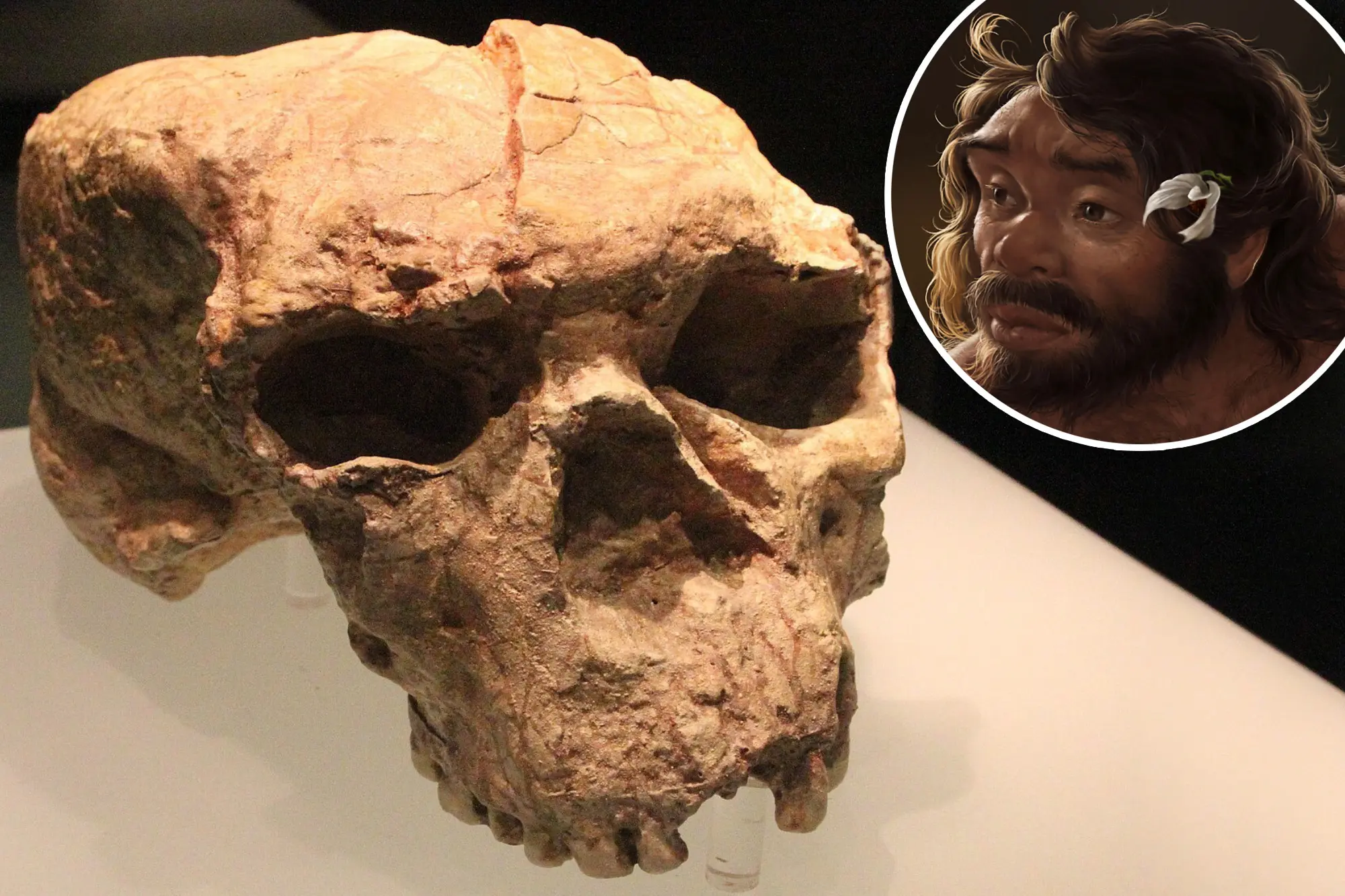


A digital reconstruction of a one-million-year-old skull from China, known as Yunxian 2, suggests that our species may have begun to emerge half a million years earlier than previously thought, according to a new study published in Science.
“We were shocked when we saw the results,” said Prof. Xijun Ni of Fudan University, who co-led the research, as reported by the BBC. “How could this be so far back in time?”
The Yunxian 2 skull, an ancient cranium, was originally unearthed in 1990 from an archaeological repository in Hubei province, central China, according to Live Science.
This discovery could rewrite the timeline of human evolution, offering a glimpse into the deep past of our species.

The unreconstructed Yunxian 2 skull is currently housed at the Hubei Provincial Museum.
For decades, researchers assumed this ancient cranium belonged to Homo erectus, the first large-brained humans, because it dated back a million years—long before advanced humans were thought to have appeared. This early hominid eventually evolved, and around 600,000 years ago, its line split into Neanderthals and Homo sapiens, the BBC reported.
However, using CT scans to digitally reconstruct the crushed and distorted face, a team of researchers from China and the UK discovered that the skull actually belonged to an early Asian hominid lineage known as the Denisovans.

Homo sapiens trace their evolutionary roots back to Dryopithecus primates, which lived up to 14 million years ago.
Although Denisovans went extinct nearly 30,000 years ago, their existence was only confirmed in 2010 through DNA evidence.
The Yunxian 2 skull exhibits traits—such as a large cranial capacity, a long and low frontal skull, and a narrow space between the eye sockets—that align with the Homo longi clade, a species as advanced as Neanderthals and Homo sapiens.
“The Homo longi clade, which includes the Denisovans, persisted for over a million years,” said study co-author Chris Stringer, a paleoanthropologist at London’s Natural History Museum, speaking to Live Science. “The Neanderthal and sapiens lineages endured just as long.”
Evidence indicates that Yunxian 2 may have lived alongside these other human species, suggesting that all three coexisted on Earth around a million years ago.

An artist’s impression imagines what Yunxian 2 might have looked like a million years ago.
If this groundbreaking analysis is correct, it suggests that large-brained humans appeared half a million years earlier than previously believed.
“We tested it again and again, using all models and methods, and now we are confident in the result. We’re actually very excited,” said Professor Ni.
Study co-author Chris Stringer also believes there may be one-million-year-old Homo sapiens fossils still waiting to be discovered.
The evidence indicates that these three human species—Homo sapiens, Neanderthals, and Denisovans—diversified rapidly, though the reasons behind this accelerated evolution remain unclear. With the timeline pushed so far back, researchers like Stringer hope to identify the environmental catalysts.
“For example, two severe cold events around 1.1 million and 900,000 years ago may have driven evolutionary and behavioral changes,” he explained.
However, the research comes with caveats. Some experts question the accuracy of the methods used to identify the species and determine their timeline, which relied on both skull morphology and genetic analysis.

The restored Yunxian 2 skull, dating back one million years, is displayed at the Hubei Provincial Museum in Wuhan, central China.
“One has to be particularly cautious about timing estimates, because they are very difficult to determine, whether using genetic or fossil evidence,” said Dr. Aylwyn Scally, an evolutionary geneticist at Cambridge University. “Even with large amounts of genetic data, it is challenging to pinpoint when these populations co-existed—sometimes within 100,000 years or more.”
While it may be tempting to suggest that Homo sapiens originated in Asia—especially since the earliest known African evidence of the species is only about 300,000 years old—Stringer emphasizes that there is currently insufficient evidence to confirm this hypothesis.


